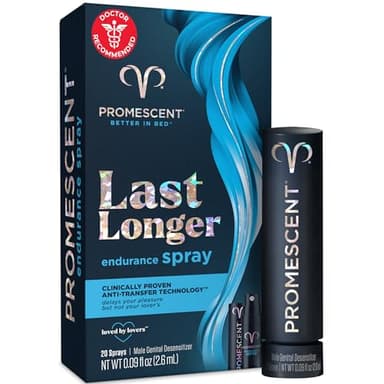
Promescent is a delay spray for premature ejaculation (PE): a lidocaine solution sold without a prescription, made by Absorption Pharmaceuticals. This long-form review explains how lidocaine works, what the label actually says, what the trial evidence does and does not show for this product, the questions people ask most about partners, condoms and timing, how it compares with wipes and with K-Y Duration, and what it costs per use. For the short verdict with pros and cons, see our Promescent spray product page. For every PE treatment, from techniques to prescription options, start with our premature ejaculation guide.
How Promescent works: lidocaine and the label
Promescent's active ingredient is lidocaine, about 10 mg per spray, listed on the label for "temporarily slowing the onset of ejaculation". DailyMed lists it as an over-the-counter monograph drug, at a strength of 10 g of lidocaine per 100 g (Promescent lidocaine spray — DailyMed).
Lidocaine is an amide-type local anesthetic. It stabilizes nerve cell membranes by blocking the ion flows that nerves need to start and carry signals, which is what produces numbness; this description comes from the FDA label of a prescription lidocaine-prilocaine cream (Lidocaine and Prilocaine Cream — DailyMed Drug Label). Applied to the penis, the aim is to reduce the sensitivity of the head of the penis and so delay ejaculation PMID: 41144023.
The spray also contains water, alcohol, glycerin, silicones and plant oils, including macadamia seed oil, among its inactive ingredients (Promescent label). The oil matters for condoms, covered below.
Promescent: how many sprays, and how to use it
The label directions, in full (Promescent label):
- "Apply 3 or more sprays, not to exceed 10, to head and shaft of penis 10 minutes before sexual intercourse, or use as directed by a doctor."
- "Recommended Initial Dosage: 3 sprays."
- "Rub Promescent into the skin of the penis until all of the product is absorbed."
- Wash the product off after sex.
The pump has to be primed before first use, and the bottle has a child-resistant lock. The label does not set a maximum number of sprays per day. Starting at 3 and adding sprays on later occasions, within the 10-spray limit, is consistent with the label.
Does Promescent work? The evidence for lidocaine sprays
Promescent's case rests mostly on evidence for its ingredient, which is positive but has quality limits. An umbrella review of 44 meta-analyses covering 65 randomized trials found that topical anesthetics significantly lengthened time to ejaculation compared with placebo. Topical anesthetics and paroxetine were the only two treatments whose evidence reached a moderate-to-high certainty rating, though topical anesthetics also had more side effects than placebo (risk ratio 4.1). The same review cautioned that only 6 of the 65 trials had a low risk of bias and that differences between meta-analyses may limit how robust the findings are PMID: 40326158.
The individual trials differ in what they tested:
- Lidocaine 5% spray. In a single-blind, placebo-controlled trial of 150 men with lifelong PE, a lidocaine 5% spray significantly improved ejaculatory latency and PE scores over 8 weeks compared with an alcohol spray placebo PMID: 31896832. Two details differ from Promescent: that spray was half the strength, and it was applied 10 to 20 minutes beforehand and then cleaned off before sex, rather than rubbed in and left on.
- Lidocaine spray against other anesthetics. In a randomized study of 273 men with lifelong PE, lidocaine spray produced the largest gain in latency, ahead of lidocaine-prilocaine cream and benzocaine condoms. The groups were unequal in size (126 men used the spray), there was no placebo group, and follow-up was short-term PMID: 41144023.
- Lidocaine-prilocaine spray. The largest placebo-controlled trials tested a lidocaine-prilocaine spray (PSD502) that is not FDA-approved in the US; the AUA/SMSNA guideline states that none of the drug treatments for PE has FDA approval PMID: 34961344. In 300 men in Europe, average latency rose from 0.6 minutes to 3.8 minutes on the spray, against 1.1 minutes on placebo PMID: 19245438. In 256 men in the US, Canada and Poland, it rose from 0.56 to 2.60 minutes, against 0.53 to 0.80 minutes on placebo PMID: 20584124. These are useful evidence for the drug class, but they are a different formula from Promescent.
What Promescent's own study showed, and its limits
No randomized or placebo-controlled trial of Promescent itself has been published. The one published study of the product was a 14-day online diary study of 91 men with self-reported early ejaculation, recruited through social media and advertising. They were mailed a sample, asked to use it on about every other occasion, and filled in a daily online report. Average estimated ejaculation time was 11.16 minutes when they used the spray and 6.81 minutes when they did not, and both partners reached orgasm on 65.6% of occasions with the spray against 44.1% without it PMID: 27557610.
Those numbers need careful reading, and the same paper's full text explains why PMID: 27557610:
- No placebo and no blinding. Men knew when they were using the spray, so expectation could explain part of the difference.
- Self-estimated timing. Latency was estimated by the men, not timed with a stopwatch as in the drug trials above.
- Self-selected, self-estimated PE. Men joined because they reported ejaculating sooner than they wanted. The paper reports an average baseline score of 13.48 on the Premature Ejaculation Diagnostic Tool, which its authors say indicates a clinical diagnosis of PE was very likely PMID: 27557610. But the men's own estimated latency before using the product averaged about 6.5 minutes. In this site's reading, that self-estimate is above the roughly 1-minute (lifelong) or 3-minute (acquired) thresholds in the International Society for Sexual Medicine definition of PE PMID: 24848805, so the sample may differ from the men studied in the drug trials above.
- Incentives and funding. Participants who completed at least four days received a $20 gift card, and one of the study's two authors disclosed funding from Absorption Pharmaceuticals.
A trial of Promescent against placebo was registered in 2014 with an estimated 120 men, but its record lists the status as unknown and has no posted results (ClinicalTrials.gov NCT02241460, checked October 3, 2026). The Amazon listing's title calls the spray "clinically proven"; on the published evidence, it is the ingredient that has controlled trials, not this product.
That is why Promescent gets an evidence grade of B on this site rather than A, and a rating of 3.9 out of 5: grade B for lidocaine's trial support, plus a small adjustment for its adjustable over-the-counter dosing. Anecdotes on forums and retail review pages vary widely and are not evidence either way.
Promescent side effects
The common side effects of topical anesthetics are local: reduced sensation that goes further than intended, and irritation. In the lidocaine 5% trial, local side effects were described as tolerated PMID: 31896832; in the 273-man comparison, side effects were minimal overall PMID: 41144023; and in the 300-man lidocaine-prilocaine trial, 2.6% of men reported local treatment-related side effects, with no systemic side effects PMID: 19245438.
The Promescent label's warnings are (Promescent label):
- Do not use it if you or your partner are allergic to lidocaine or topical anesthetics, or if your partner is or may be pregnant.
- Ask a doctor or pharmacist first if you have liver problems. Lidocaine is metabolized rapidly by the liver, and severe liver disease raises the risk of toxic blood levels of local anesthetics (Lidocaine and Prilocaine Cream — DailyMed Drug Label).
- Do not spray it on broken, irritated or sensitive skin, and avoid the eyes.
- Stop if you or your partner develop a rash or irritation such as burning or itching, and see a doctor if it persists.
- If it does not help when used as directed, stop and see a doctor, because PE may be due to a condition that needs medical supervision.
Fertility. In a laboratory study using semen samples from 20 men, adding Promescent significantly reduced sperm motility, forward movement and viability, with no significant difference in sperm DNA fragmentation PMID: 29307732. That was a test-tube study, not a fertility trial, but couples trying to conceive should discuss it with a clinician.
Does Promescent transfer to your partner?
It can. Any anesthetic left on the skin can reach a partner during sex, and partners have reported effects in trials: in the 300-man lidocaine-prilocaine spray trial, 3.1% of partners reported local treatment-related side effects PMID: 19245438. That trial used a different formula, applied 5 minutes before sex.
Promescent's Amazon listing says its "Anti-Transfer Technology" is absorbed into the skin and, used as directed, "virtually eliminates the risk of numbing your partner" (listing viewed October 3, 2026). No published study was found that measured partner transfer with Promescent, so treat that as the maker's claim. The label's own instructions are the practical safeguard: rub it in until absorbed, wash it off after sex, stop if either partner gets irritation, and do not use it at all if your partner is or may be pregnant (Promescent label).
Can Promescent be used with condoms?
The label says nothing about condoms either way (Promescent label). The maker's Amazon listing states that it "is compatible with both latex and polyisoprene condoms" and advises waiting 5 to 10 minutes for it to absorb before putting on a condom (listing viewed October 3, 2026). No published test data behind that statement were found.
There are two reasons to be careful. First, the spray contains macadamia seed oil, and FDA's recommended labeling for latex condoms warns against oil-based lubricants "as these may damage the condom" (FDA latex condom labeling guidance). Polyisoprene condoms, a common latex-free option, are just as sensitive to oil as latex (WHO/UNFPA/FHI 360 advisory note); our guide to lubricants and condoms explains which lubricants suit each condom material. Whether the small amount of oil in a few sprays weakens a condom has not been tested in any study cited here. Second, a product being absorbed is not the same as a product being condom-safe: absorption describes what happens on the skin, while condom compatibility is something that has to be tested on the condom material.
Labels for similar products differ. The label of K-Y Duration, another lidocaine spray, states plainly that "This product is not compatible with condoms" (K-Y Duration for Him — DailyMed). If you rely on condoms for contraception or infection protection, ask Promescent's maker about your specific condom type before relying on the combination. Our condom guide covers the main condom materials and which lubricants suit each.
How long does Promescent last?
No study has measured how long Promescent's numbing effect lasts. The label covers only timing before sex (10 minutes) and washing it off afterwards (Promescent label). The maker's Amazon listing says the effect "generally lasts about an hour" and that results vary with sensitivity and the amount used (listing viewed October 3, 2026). In trials, application times ranged from 5 minutes before sex for the lidocaine-prilocaine spray PMID: 19245438 to 10 to 20 minutes for the lidocaine 5% spray PMID: 31896832. If the spray numbs too much, use fewer sprays next time rather than a longer wait.
Promescent spray vs wipes, condoms and K-Y Duration
Promescent also sells benzocaine wipes, and there are other delay formats. On the evidence, lidocaine sprays lead. In the head-to-head study, benzocaine condoms produced a smaller gain than lidocaine spray but had the fewest side effects PMID: 41144023, and no PubMed-indexed trial of benzocaine wipes was found.
| Promescent spray | Promescent Delay Wipes | K-Y Duration spray | |
|---|---|---|---|
| Active ingredient | Lidocaine, about 10 mg per spray | Benzocaine 7% | Lidocaine 9.6%, about 10 mg per spray |
| Label directions | 3 to 10 sprays, 10 minutes before sex; start with 3; rub in until absorbed | A small amount to the head and shaft before sex | 3 to 10 sprays before sex; no more than 20 sprays in 24 hours |
| Condoms (label) | Not addressed | Not addressed | "Not compatible with condoms" |
| Pregnancy (label) | Do not use if your partner is or may be pregnant | Not addressed | Ask a health professional if pregnant or breastfeeding |
| Published controlled trial of the product | None | None | None found in a PubMed search (October 2026) |
Sources: the Promescent spray label, the Promescent Delay Wipes label and the K-Y Duration label.
Promescent vs K-Y Duration. The two are close: both are lidocaine sprays delivering about 10 mg per spray with the same 3-to-10-spray range. K-Y Duration's label adds a 24-hour limit and rules out condoms; Promescent's label instead warns against use when a partner may be pregnant and mentions liver problems. K-Y Duration is not in this site's catalog, so it is not ranked here. If you prefer a wipe, our Promescent Delay Wipes review covers the benzocaine option.
How much does Promescent cost per use?
When checked on October 3, 2026, the Amazon listing for a 2.6 ml bottle (2.6 g on the label) was $22.95, sold by Absorption and shipped by Amazon. The current price is $22.95.
Neither the label nor the listing says how many sprays a bottle holds, so the cost per use below is an estimate. The label gives a lidocaine strength of 10 g per 100 g and about 10 mg per spray, which works out to roughly 0.1 g of product per spray. The label lists a 2.6 g bottle among its package sizes, so a bottle holds about 26 sprays, a few fewer once some are used to prime the pump (Promescent label). That is about $0.88 per spray: about $2.65 per use at the starting dose of 3 sprays, and about $8.83 at the 10-spray maximum.
For comparison, the K-Y Duration label states 36 sprays in a 5.0 mL bottle (K-Y Duration label), and it was listed on Amazon at $19.97 on the same date, about $0.55 per spray. Promescent Delay Wipes were $19.95 for 7 wipes, about $2.85 per wipe. The example below assumes 8 uses a month; it is an illustration, not a recommendation.
Example monthly cost of delay products (estimates)
| Choose | Item | Per month | Per year |
|---|---|---|---|
| Promescent spray, 3 sprays per use (about 26 sprays per $22.95 bottle, estimated)$2.65 x 8 per month | $21.20 | $254.40 | |
| Promescent spray, 10 sprays per use (label maximum)$8.83 x 8 per month | $70.64 | $847.68 | |
| Promescent Delay Wipes, 1 wipe per use ($19.95 per 7)$2.85 x 8 per month | $22.80 | $273.60 | |
| K-Y Duration, 3 sprays per use (36 sprays per $19.97 bottle)$1.66 x 8 per month | $13.28 | $159.36 | |
| Total | $21.20 | $254.40 | |
Prices are list or typical cash prices on October 3, 2026; your pharmacy price varies.
At 8 uses a month and the starting dose, Promescent comes to about $21 a month, close to the price of one bottle. Using more sprays per occasion raises the cost quickly.
Who Promescent suits, and when to see a clinician
Promescent may suit you if:
- You want a non-prescription first option and would like to adjust the dose.
- Your partner is not pregnant or trying to become pregnant, and neither of you is allergic to topical anesthetics.
- You are willing to rub it in, wait, and wash it off afterwards.
See a clinician first, or instead, if:
- Your timing changed noticeably after years without a problem, or you also have erection problems, pelvic pain or urinary symptoms. In a study of men with acquired PE, anxiety, depression, erectile dysfunction and chronic prostatitis were all common PMID: 31477853, and erection problems are covered in our erectile dysfunction guide.
- You have liver problems, as the label advises.
- The spray has not helped after a fair trial within the label's dosing. Prescription options exist. Lidocaine-prilocaine cream is a prescription product labeled for numbing skin and genital mucous membranes before minor procedures (Lidocaine and Prilocaine Cream — DailyMed Drug Label), so using it for PE is off-label with evidence PMID: 41144023. SSRIs such as paroxetine are also off-label with evidence, and the AUA/SMSNA guideline states that none of the drug treatments for PE has FDA approval PMID: 34961344. Dapoxetine, a short-acting SSRI studied for PE, has no FDA approval: FDA's Drugs@FDA data (openFDA query; Drugs@FDA) returned no dapoxetine product on October 3, 2026. Our premature ejaculation guide covers each, along with behavioural techniques, and our guide to Kegel exercises covers pelvic floor training.
Promescent review: the verdict
Promescent is a reasonable first step for premature ejaculation. Its ingredient, lidocaine, has placebo-controlled trial support, the label lets you adjust the dose, and it costs a few dollars per use at the starting dose. Its weaknesses are the product's own evidence, which is one uncontrolled, partly maker-linked diary study, the lack of any label statement on condoms despite an oil in the formula, and the real chance of numbing a partner. Use it as directed, keep it away from a partner who may be pregnant, and see a clinician if it does not help. Our Promescent spray product page has the short verdict.