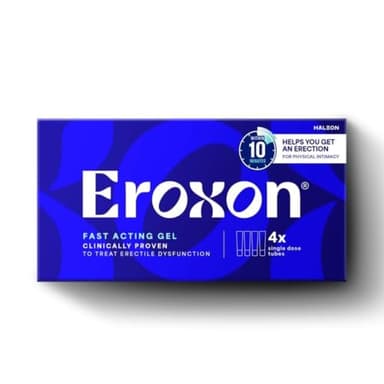
Eroxon is a gel for erectile dysfunction (ED) that is sold without a prescription and contains no drug. It is made by Futura Medical and reached the US market as a medical device, not a medicine. This long-form review goes through how it is meant to work, what its FDA authorization does and does not mean, what the trial behind it actually measured, how it compares with prescription tablets such as Viagra, and what it costs per use. For a short verdict with pros and cons, see our Eroxon product page. For the causes of ED and the full range of treatments, start with our erectile dysfunction guide.
Most of the trial detail on this page comes from one primary source: FDA's own decision summary for Eroxon, which describes the pivotal study the company submitted (FDA decision summary, DEN220078). We did not find a peer-reviewed publication of the trial, so the summary is the most detailed independent account available.
How does Eroxon work? The mechanism of action
Eroxon is a hydro-alcoholic gel: mostly alcohol and water, with glycerin, propylene glycol, a thickener (carbomer) and potassium hydroxide to adjust pH. None of these is a drug. Each single-use aluminium tube dispenses about 300 mg of gel, which is applied to the head of the penis before intercourse (FDA decision summary, DEN220078).
FDA describes the mechanism this way: the alcohol and water evaporate, causing a rapid cooling effect on the head of the penis followed by a slower warming effect. This temperature change stimulates nerve endings, leading to tumescence and erection (FDA Roundup, June 13, 2023). In bench testing, the gel produced that cooling-then-warming temperature profile under simulated conditions of use (FDA decision summary, DEN220078).
That is a different route from prescription ED tablets. Sildenafil (Viagra) and tadalafil (Cialis) are absorbed into the body and block the PDE5 enzyme, which helps blood vessels in the penis relax in response to sexual stimulation (Viagra (sildenafil) — DailyMed Drug Label; Cialis (tadalafil) — DailyMed Drug Label). Eroxon works on the skin surface and has no drug to absorb.
Is Eroxon FDA approved? What De Novo authorization means
Strictly, no. "Approval" is the term for drugs, and Eroxon is not a drug. Nor was it "cleared" through a 510(k), the device route that relies on comparison with a legally marketed predicate device. Eroxon went through FDA's De Novo pathway, which exists for novel medical devices that have no such predicate (FDA: De Novo Classification Request).
FDA received Futura Medical's request on October 21, 2022, and granted it on June 9, 2023 (FDA De Novo record DEN220078). The decision created a new device type, "non-medicated topical formulation for treatment of erectile dysfunction", in Class II (regulation 21 CFR 876.5021, product code QWW), with special controls: future products of this type must show biocompatibility, condom compatibility, the temperature profile and shelf life, and their labeling must state that the product is not a contraceptive (FDA decision summary, DEN220078). FDA described Eroxon as the first over-the-counter gel intended to treat erectile dysfunction, authorized for adult men aged 22 and over (FDA Roundup, June 13, 2023).
So the accurate phrase is "FDA-authorized through the De Novo pathway". Some retail listings call it "FDA-cleared"; the Amazon listing title did when it was checked on October 2, 2026.
Does Eroxon work? What the pivotal trial showed
The study FDA relied on was a multi-centre, international, open-label home-use trial lasting 24 weeks. It randomized 96 men aged 22 to 68 with ED of at least three months, 48 to Eroxon and 48 to tadalafil 5 mg tablets, mostly in Poland and Georgia, with 9 in the US (FDA decision summary, DEN220078). Erectile function was scored with the erectile function domain of the International Index of Erectile Function (IIEF-EF), a standard questionnaire.
The main results for the Eroxon group, as FDA reports them (FDA decision summary, DEN220078):
- Average improvement: the IIEF-EF score rose by 5.73 points from baseline at 24 weeks (95% confidence interval 3.8 to 7.7). The trial's goal was at least 4 points, the minimal clinically important difference, so both primary endpoints were met.
- Responders: 62% of men improved by more than 4 points.
- Speed: FDA reports 62.6% for noticing an erection within 10 minutes of applying the gel, and 55.7% for being able to have intercourse within 15 minutes. FDA defined these endpoints as the average share of uses per man, though its results text describes them as percentages of subjects.
- Dropouts: 41 of 48 men (85.4%) completed the 24 weeks; 3 stopped because the gel was not working for them.
A 2024 scoping review of topical ED treatments reported the same 5.73-point figure for Eroxon (studied under the code name MED3000) and judged it above the clinically meaningful threshold PMID: 39128025. That review also noted that its efficacy relative to current first-line therapies remains unclear.
The limits of the Eroxon evidence
The headline numbers are real, but the design behind them is weaker than the evidence for prescription tablets, and it is worth being clear about why.
- No placebo group. The 5.73-point gain is a change from each man's own starting score. Without a placebo gel for comparison, there is no way to tell how much of that gain came from the gel itself rather than from expectation, the attention of being in a trial, or natural variation. FDA's summary does not report a placebo result (FDA decision summary, DEN220078).
- Open-label. Everyone knew which treatment they were using.
- The tadalafil arm was not a comparison. FDA states that the tadalafil group was exploratory and was not used to compare safety or effectiveness against Eroxon. The trial does not show whether Eroxon is better or worse than a tablet.
- Small numbers. Only 48 men were assigned to Eroxon. FDA reports improvement figures by ED severity (55% mild, 45% moderate, 86% severe) without explaining how they were calculated, and the severe group had just 12 men, so those subgroup figures are fragile.
- A selected group. The trial required some remaining erectile function and a steady relationship with a female partner of at least six months. It excluded men with significant heart, lung, liver, kidney or neurological disease, severe or uncontrolled diabetes, a history of radical prostatectomy, men taking nitrates, alpha blockers or two or more blood pressure medicines, and men whose ED had not responded to PDE5 tablets (FDA decision summary, DEN220078). Results may not apply to those groups.
Expert opinion is supportive but also cautious, and some of it has industry ties. A 2025 narrative review concluded that topical therapies, including this gel, may provide an effective alternative for men who require or prefer one; all four of its authors disclosed advisory roles with Futura Medical or Haleon, and Haleon supported the manuscript's development PMID: 40356742. A 2026 Delphi consensus on where Eroxon fits, whose authors include three of that review's authors, agreed on 31 statements, but noted that some questions about Eroxon could not reach consensus and need further analysis of the trial results and new real-world data, most notably how well it works in different groups of men PMID: 42696760.
For these reasons, Eroxon gets an evidence grade of B on this site, not A, and a rating of 3.8 out of 5. It has a regulator-reviewed trial that met its goals, but not the randomized, placebo-controlled evidence that supports the prescription tablets.
Eroxon vs Viagra and other PDE5 tablets
There is no head-to-head trial, so the comparison below is about what each product is and how strong its evidence is, not about which works better.
| Eroxon gel | Sildenafil (Viagra) | |
|---|---|---|
| FDA status | Class II medical device, De Novo authorized (2023) | FDA-approved prescription drug |
| Active drug | None (alcohol, water and gel ingredients) | Sildenafil citrate |
| Prescription needed | No | Yes |
| How it is used | Applied to the head of the penis before intercourse | Tablet taken 30 minutes to 4 hours before sex |
| Main evidence | One open-label trial arm of 48 men, no placebo | Many randomized trials against placebo or other PDE5 tablets |
| Men who take nitrates | Not studied (excluded from the trial) | Must not take it |
| Cost per use | About $6.49 a tube (Amazon, October 2, 2026) | About $0.05 a generic 50 mg tablet (Cost Plus Drugs, October 2, 2026), plus fees, shipping and a prescription |
The evidence gap is large. A network meta-analysis of PDE5 tablets pooled 82 randomized trials with more than 47,000 men, comparing them against placebo or against each other PMID: 25817916. Eroxon's clinical evidence rests on one trial arm of 48 men (FDA decision summary, DEN220078). The sildenafil figures in the table come from its FDA label, which also says men taking nitrates must not use it (Viagra (sildenafil) — DailyMed Drug Label).
Eroxon's practical advantages are that it needs no prescription and puts no drug into the body. Its disadvantages are thinner evidence and a higher cost per use. If the most reliable result is the goal, prescription tablets are the better-studied choice; our sildenafil vs tadalafil comparison covers timing, side effects and cost for the two most common ones.
Can Eroxon be used with Viagra?
There is no evidence on combining them. The pivotal trial excluded men taking sildenafil, vardenafil or other PDE5 inhibitors, and required men to stop other ED treatments for the whole study (FDA decision summary, DEN220078). Ask a clinician or pharmacist before using the two together.
Eroxon side effects and safety
Side effects in the pivotal study were few. Any adverse event, related to treatment or not, was reported by 36.2% of men using Eroxon (17 of 47) and 46.8% on tadalafil (22 of 47). Only one Eroxon user (2.1%) had an event judged to be caused by the treatment: mild burning where the gel was applied, which went away after he stopped. Two men on tadalafil had treatment-related headaches. FDA notes that the tadalafil figures were not used for comparison (FDA decision summary, DEN220078).
The label cautions summarized by FDA are (FDA decision summary, DEN220078):
- Do not use it if you are allergic to any ingredient.
- Stop if burning, itching or redness occurs, and seek medical advice if irritation continues.
- Do not use it under age 22, with any disease or deformity of the penis, on red, sore or broken skin, or if a doctor has advised you to avoid sexual activity.
Partners. Female partners in the trial were monitored for adverse events through diaries (FDA decision summary, DEN220078). The summary does not report any partner-specific side effects, but it also does not break partner data out separately, so absence of a reported problem is not proof of none.
Condoms and contraception. In bench testing, Eroxon did not significantly affect the strength of natural rubber latex, polyisoprene or polyurethane condoms, which supports the label's statement that it is compatible with all three. It is not a contraceptive (FDA decision summary, DEN220078).
Heart health. Eroxon has not been studied in men with significant cardiovascular disease, because the trial excluded them. ED itself can be an early warning: in a JAMA analysis of over 9,400 men aged 55 and over, ED was associated with a higher rate of later cardiovascular events, and the authors concluded that ED should prompt a check of cardiovascular risk factors PMID: 16414947. Over-the-counter access is convenient, but it should not replace that checkup, especially if ED is new or worsening.
How to use Eroxon, and how long it lasts
Each tube is a single dose of about 300 mg, applied to the head of the penis shortly before intercourse. The tubes are single-use and non-sterile, and FDA accepted a 12-month shelf life (FDA decision summary, DEN220078). The package insert covers how to apply it and how often it can be used; follow it rather than general advice.
How long the effect lasts is not something FDA's summary reports. FDA's summary describes measures of how quickly an erection started and of overall erectile function over 24 weeks, not of how long each erection lasted. Treat claims about duration on retail listings with caution.
The trial excluded men with severe premature ejaculation. If the main concern is ejaculating sooner than you would like rather than erections, different treatments apply; see our premature ejaculation guide.
How much does Eroxon cost per use?
When checked on October 2, 2026, the Amazon listing for a pack of 4 single-use tubes was $25.97, sold by Amazon.com, which works out at about $6.49 per use. The current price is $25.97.
Generic sildenafil is much cheaper per dose but needs a prescription. On the same date, Mark Cuban Cost Plus Drug Company's public pricing API listed generic sildenafil 50 mg at $0.04537 a tablet, plus a $5 dispensing fee and $5.25 shipping per order (product page). The cost of the prescription itself, whether an in-person or online visit, is extra and varies; our comparison of online ED services lists what those services publish. The example below assumes 8 uses a month; it is an illustration, not a recommendation.
Example monthly cost: Eroxon vs generic sildenafil
| Choose | Item | Per month | Per year |
|---|---|---|---|
| Eroxon gel, 8 tubes (Amazon, $25.97 per 4)$6.49 x 8 per month | $51.94 | $623.28 | |
| Generic sildenafil 50 mg, 8 tablets, plus $5 dispensing fee and $5.25 shipping (Cost Plus Drugs; prescription not included)$1.33 x 8 per month | $10.61 | $127.36 | |
| Total | $51.94 | $623.28 | |
Prices are list or typical cash prices on October 2, 2026; your pharmacy price varies.
At 8 uses a month, Eroxon comes to about $52 and generic sildenafil from Cost Plus to about $10.61 including fees and shipping, before the cost of getting a prescription. Ordering tablets less often, or several months at once, changes the per-month figure.
Who Eroxon suits, and who should skip it
Eroxon may suit you if:
- You want a non-prescription option and are not ready to see a clinician, or want something to use while you arrange a visit.
- You prefer not to take a drug, or a clinician has told you PDE5 tablets are not suitable for you.
- You have mild to moderate ED and still have some erectile function, which is the group the trial mostly studied.
Skip it or see a clinician first if:
- ED is new, getting worse, or comes with chest pain, breathlessness, low desire or low energy. Our erectile dysfunction guide explains which checks make sense.
- You have heart disease, take nitrates, or have had your prostate removed (radical prostatectomy). These groups were excluded from the trial. Vacuum devices have been tested after prostate surgery, including in a randomized trial of 109 men PMID: 16107868; see our vacuum erection device guide.
- You want the most proven option. Prescription PDE5 tablets have a far larger evidence base and cost less per dose.
- You are weighing a "male enhancement" supplement instead. FDA has repeatedly found hidden prescription drugs in such products (FDA sexual enhancement product notifications); see our guide to male enhancement supplements and FDA warnings.
- You have any condition of the penis, or irritated or broken skin.
Eroxon review: the verdict
Eroxon is a genuinely new kind of ED treatment: a drug-free gel that FDA authorized through its De Novo pathway after a trial in which men's erectile function scores improved by a clinically meaningful amount. The weakness is the evidence behind that result. It is one open-label trial arm of 48 men with no placebo comparison and no head-to-head data against tablets. It is a reasonable first step for men who want a non-prescription, non-drug option, but it is not a replacement for a checkup, and it is not the best-studied treatment. Our Eroxon product page has the short verdict and pros and cons.