Pelvic floor trainers are app-connected devices that measure how hard you squeeze your pelvic floor muscles and turn the exercise into a game or a graph. They are sold as a smarter way to do Kegels. The research supports the exercises, known as pelvic floor muscle training (PFMT), much more strongly than it supports the device. So this page does not open with a ranked list. It explains what PFMT does, what a trainer adds, when a device is worth the money and when a pelvic floor physical therapist is the better first step. It then reviews the one trainer in this site's catalog, Perifit. For other topics, start from our sexual health guides.
Do pelvic floor trainers work? The exercises versus the device
Start with the exercises. A Cochrane review of 31 trials with 1,817 women compared PFMT with no treatment or inactive treatments. Women with stress urinary incontinence (leaking when coughing, sneezing or exercising) who did PFMT were about eight times as likely to report a cure: 56% against 6%, based on high-quality evidence. PFMT also reduced leakage episodes, and the review found that women who trained were more satisfied and had better sexual outcomes. Adverse events were rare and minor PMID: 30288727. The authors concluded that PFMT could be part of first-line treatment for incontinence in women.
A pelvic floor trainer adds biofeedback: a sensor shows you, in real time, how strongly you are contracting. The question is whether that extra information improves results. A 2025 Cochrane review of 41 studies with 3,483 women tested exactly that. In 33 studies comparing PFMT with biofeedback against PFMT alone, biofeedback made little or no difference to incontinence-related quality of life (high-certainty evidence). It reduced leakage by about 0.29 episodes a day, a difference the authors said may not be clinically important, and it probably made little or no difference to whether women felt cured or improved. Women who used biofeedback may have been more satisfied with treatment, but that evidence was low certainty PMID: 40066950.
A large UK trial points the same way. In the OPAL trial, 600 women with stress or mixed incontinence were randomly assigned to basic PFMT or PFMT with electromyography (EMG) biofeedback, including a home biofeedback unit. Both groups were offered six therapist appointments over 16 weeks. After 24 months, incontinence severity scores were almost identical (8.2 against 8.5 on a 21-point scale), and the authors found no evidence of a difference between the two PMID: 33289476. OPAL used EMG biofeedback, which senses the muscles' electrical activity, rather than force sensors like Perifit's, but it was a large, long-term test of adding home biofeedback to training.
Put simply: the training does the work. A device can make the training easier to do, and some people prefer it, but it has not been shown to make the training more effective.
Best pelvic floor trainer for incontinence: start with supervised training
Clinical guidelines reflect that evidence. NICE, the guideline body for England, recommends offering a trial of supervised pelvic floor muscle training lasting at least 3 months as the first-line treatment for women with stress or mixed urinary incontinence, with at least 8 contractions 3 times a day (NICE guideline NG123, recommendations 1.4.4 and 1.4.5). It recommends that a clinician check the contraction by internal examination before supervised training starts (NICE NG123, recommendation 1.3.4).
On devices, NICE is specific. It advises against using perineometry (FDA classifies Perifit as a perineometer) or pelvic floor EMG as biofeedback as a routine part of training (a 2006 recommendation retained in the 2019 guideline). It does say electrical stimulation and/or biofeedback should be considered for women who cannot actively contract their pelvic floor muscles, to aid motivation and adherence (NICE NG123, recommendations 1.4.6 and 1.4.10).
So the honest answer to "which trainer is best for incontinence" is that the strongest option is a supervised program, which in practice usually means working with a pelvic floor physical therapist (called a pelvic health physiotherapist in some countries). A home trainer is an optional add-on. It makes most sense if you:
- have already been shown how to contract the right muscles, ideally by a therapist,
- struggle to keep doing the exercises without reminders or feedback, and
- understand that you are paying for convenience and motivation, not a proven extra effect.
Is Perifit FDA approved? What its clearance means
Perifit is a medical device, so it is FDA-cleared, not FDA-approved. FDA cleared it through the 510(k) process on February 10, 2023 (K221476), as a Class II device under the regulation for perineometers, product code HIR (FDA 510(k) K221476; FDA product classification HIR). Its Amazon listing title (viewed October 3, 2026) describes it as "FDA-Approved"; clearance is the accurate term.
According to the 510(k) summary, Perifit is a rigid probe in a silicone sheath that is inserted into the vagina. Sensors measure the force of pelvic floor contractions and send it by Bluetooth to a smartphone app. It is cleared for over-the-counter use, and its indication reads: "a perineometer designed to treat stress, mild-moderate urge and mixed urinary incontinence in women, by strengthening of the pelvic floor muscles through exercise," indicated "for an adult female" (Perifit 510(k) summary).
A 510(k) clearance means FDA found the device substantially equivalent to an earlier one, here the PeriCoach OTC trainer (K160758). The performance data in the summary are biocompatibility, electrical safety, software and mechanical testing plus a questionnaire on whether users understood the labeling; the summary does not describe a clinical trial of Perifit (Perifit 510(k) summary). Clearance tells you the device is regulated and comparable to its predecessor. It does not tell you it beats exercising without one.
What the Perifit evidence shows
The only published study of Perifit that a PubMed search for this review found (October 3, 2026) is an analysis of real-world data. It included 6,060 women with urinary incontinence who had bought the device and filled in a validated symptom questionnaire before training and at one or more later points. Average symptom scores fell from 8.4 to 4.6 points by the time users had completed 280 to 300 of the app's games, and 85% of those responding at that point reported improvement PMID: 38516650.
Those numbers need context:
- No control group. Without a comparison group of women doing the same exercises without the device, or doing nothing, the study cannot separate the effect of Perifit from the effect of PFMT, from natural improvement, or from regression to the mean.
- Self-selected respondents. Everyone had bought the device, and only those who completed questionnaires were counted, so the people who stopped using it may be under-represented.
- Company authors. Both authors are full-time employees of X6 Innovations, which makes Perifit PMID: 38516650.
Because the Cochrane evidence shows biofeedback adds little to PFMT PMID: 40066950 and the device-specific data are uncontrolled, this site grades Perifit's evidence C (limited). The training it guides is well supported; the device's added value is not.
Pelvic floor training and sexual function in women
Pelvic floor training is also studied for sexual function, with weaker evidence than for incontinence. A 2024 systematic review in the American Journal of Obstetrics and Gynecology included 21 randomized trials of PFMT in women. In the four trials that could be pooled, PFMT improved overall Female Sexual Function Index scores and the arousal, orgasm, satisfaction and pain domains. The certainty of the evidence was very low because the trials varied so much, and no side effects were reported PMID: 38191016.
A 2025 meta-analysis of five randomized trials in postmenopausal women also found improvements in overall sexual function scores, particularly orgasm, arousal and satisfaction, with no significant effect on pain; scores for desire and lubrication moved in the wrong direction. Its authors described the results as heterogeneous and the evidence as limited PMID: 40979950.
None of these trials tested a consumer trainer. If sex is painful after menopause, the main causes and treatments are different, and our guide to vaginal dryness during menopause covers lubricants, moisturizers and vaginal estrogen, an FDA-approved prescription treatment (Vagifem (estradiol) — DailyMed Drug Label). For how the two best-known hormone-free moisturizers compare, see Replens vs Revaree.
Best pelvic floor trainer for men, and do trainers work for ED?
Perifit is not an option for men: its FDA clearance is for adult women, and it is used vaginally (Perifit 510(k) summary). This site's catalog has no trainer for men. Men can still do pelvic floor training, and the evidence for them is mixed.
Erectile dysfunction. In a randomized trial of 55 men with ED in the UK, those who did pelvic floor exercises with manometric (pressure) biofeedback and received lifestyle advice improved their erectile function scores by 6.74 points more at 3 months than men given lifestyle advice alone. By the end, counting control men who later switched to the exercises, 40% had normal erectile function and 25.5% had not improved PMID: 15527607. A systematic review of 10 trials concluded that PFMT appears effective for ED and premature ejaculation, but the studies were of low to moderate quality, too varied to pool, and no best training protocol has been identified PMID: 30979506. Our guide to Kegel exercises for men and women explains how to do the exercises without a device.
After prostate surgery. The evidence is less encouraging. A Cochrane review of 50 trials found the value of conservative treatments for incontinence after radical prostatectomy remains uncertain, with no evidence from eight trials that PFMT, with or without biofeedback, beat control treatment for men who already had incontinence. Across trials that also included men starting training to prevent incontinence, the review found moderate evidence of less incontinence at one year with PFMT, a finding pad tests did not support PMID: 25602133. That review's searches ended in 2014. In a UK trial of men with incontinence 6 weeks after prostate surgery, four one-to-one therapy sessions were unlikely to be effective compared with standard care that included information about PFMT PMID: 21640056. For erections after prostatectomy, a 2026 review of 12 randomized trials found inconsistent effects: four trials showed a benefit and seven found no significant difference PMID: 42671634. Vacuum devices are another option urologists use after surgery; our vacuum erection device guide covers that evidence.
Premature ejaculation. A 2026 meta-analysis of five small randomized trials found that pelvic floor training on its own had a smaller effect on ejaculatory latency than drug or combined treatments PMID: 42132359. Our premature ejaculation guide covers the treatments with better evidence.
For the causes of ED and the full range of treatments, including the checkup that new ED deserves, see our erectile dysfunction guide.
Pelvic floor training in pregnancy and after birth
Pregnancy and childbirth are common reasons people look for a trainer. A Cochrane review of 46 trials with 10,832 women found that continent pregnant women who did structured PFMT were less likely to report incontinence in late pregnancy, and slightly less likely to have it more than 3 to 6 months after birth. As a treatment for women who already had incontinence during or after pregnancy, the effect was uncertain PMID: 32378735. Two women in one small trial withdrew because of pelvic floor pain; no other trial reported adverse effects of PFMT PMID: 32378735.
Those trials studied exercise programs, not consumer trainers, and the 2025 Cochrane review of biofeedback excluded studies that recruited women who were pregnant or less than six months after birth PMID: 40066950. As general guidance: if you are pregnant or have recently given birth, ask your clinician or a pelvic health physical therapist before using any device inserted into the vagina.
How long until pelvic floor training shows results?
Plan for months. NICE recommends a supervised trial of at least 3 months before judging whether PFMT has worked for incontinence, and advises continuing the program if it helps (NICE NG123, recommendations 1.4.4 and 1.4.7). In the Perifit study, symptom scores kept falling between the earlier and later checkpoints, which were measured in games completed rather than weeks PMID: 38516650. Results depend on doing the exercises consistently and correctly, which is where supervision helps.
Are pelvic floor trainers worth it? Cost and alternatives
On Amazon on October 3, 2026, Perifit cost $149.00, sold by perifit and shipped by Amazon. The listing says the item is non-returnable for product safety reasons. Supervised training has costs too, but it is the option with the evidence. Whether a trainer counts as a flexible spending or health savings account expense depends on your plan's rules, so check with the plan administrator before you buy.
Other app-linked trainers are sold, including the Elvie Trainer and kGoal devices. They aren't reviewed here because they aren't in this site's catalog.
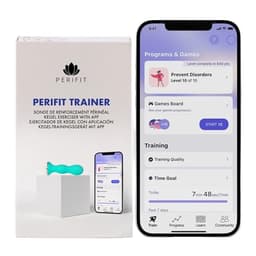
Perifit Pelvic Floor Trainer
Best For
Women with stress urinary incontinence who know the technique but find it hard to keep exercising
Works In
Benefits from pelvic floor training build over weeks to months
Price
$149.00
$149.00 / count
Pros
- ✓FDA 510(k) clearance K221476 as a perineometer for stress, mild to moderate urge and mixed urinary incontinence in women
- ✓Real-time feedback and app games may help motivation; biofeedback users may report greater satisfaction (low-certainty evidence)
- ✓Guides pelvic floor muscle training, which is well supported for incontinence in women
Cons
- ✗Adding biofeedback to pelvic floor training made little or no difference to incontinence quality of life in a 2025 Cochrane review
- ✗The only published Perifit study found on PubMed is uncontrolled and written by employees of its maker
- ✗Cleared for adult women only; not an option for men
- ✗Costly and non-returnable on Amazon
Amazon prices retrieved from the Amazon Product Advertising API on . Prices and availability are accurate as of that time and may change.
The rating follows this site's methodology: it grades the evidence for what the device adds (C, limited), then adjusts for practical factors. The cost pulls it down, because the training it guides can be done without it. Read the full Perifit review.
Safety, and when to see a pelvic floor physical therapist
PFMT itself is low risk: adverse events were rare and minor in the Cochrane review of PFMT against no treatment PMID: 30288727. Devices add a few. In the 2025 Cochrane review, the side effects that women using biofeedback reported seemed related to having a vaginal or rectal device in place, such as discomfort or vaginal discharge, and no study reported severe adverse events PMID: 40066950. In the OPAL trial, 21 women in the biofeedback group and 2 in the basic training group had a non-serious adverse event related or possibly related to the intervention PMID: 33289476. Follow the device's cleaning and use instructions, and stop if it causes pain.
See a clinician or a pelvic floor physical therapist, rather than starting with a device, if:
- you are not sure you are contracting the right muscles; NICE recommends a digital (internal) assessment to confirm the contraction before supervised training (NICE NG123, recommendation 1.3.4),
- you are pregnant, have recently given birth, or have had pelvic or prostate surgery,
- you have pelvic pain, pain during sex, or a feeling of bulging or heaviness in the vagina,
- you leak urine with urgency; NICE recommends bladder training for at least 6 weeks as the first-line treatment for urgency or mixed incontinence (NICE NG123, recommendation 1.4.11),
- your symptoms are getting worse, or have not improved after the 3-month trial of training NICE recommends (NICE NG123, recommendation 1.4.4), or
- you are a man with new erection problems; our erectile dysfunction guide explains why they deserve a checkup.