rx-sexualhealth.com

Promescent Delay Spray Review

Updated 2026-10-03 · 3 min read · Sources linked in the text

Our verdict

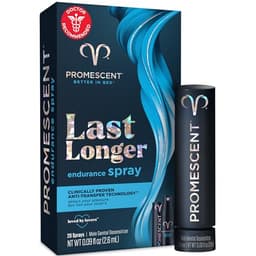
Promescent Delay Spray product photo

Promescent Delay Spray

Grade BModerate evidence

Promescent is an over-the-counter lidocaine spray, and lidocaine sprays have placebo-controlled trial support for premature ejaculation. Promescent itself has no published controlled trial, and its label says nothing about condoms, but it is the best-supported non-prescription option in our catalog.

$22.95 ($255.00 / fluid ounce)

Amazon price as of Oct 3

Best for

  • Men with premature ejaculation who want a non-prescription first option

Skip it if

  • You or your partner are allergic to lidocaine or other topical anesthetics
  • Your partner is or may be pregnant (label warning)
  • You have liver problems — ask a doctor first (label warning)
  • You rely on condoms — the label does not address condom compatibility, and the spray contains macadamia seed oil
Promescent Delay Spray key facts
Active ingredientLidocaine 10% (DailyMed label)
FormTopical spray (OTC male genital desensitizer)
OnsetApplied 10 minutes before intercourse, per the label
How to useLabel: 3 or more sprays, not to exceed 10, to the head and shaft of the penis 10 minutes before intercourse; start with 3
AgesAdult men
Exact itemPromescent lidocaine delay spray, 2.6 ml
Price$22.95 ($255.00 / fluid ounce) (amazon price as of oct 3)

How we got 3.9

3.8
Evidence grade B (moderate evidence). An umbrella review of meta-analyses rated the evidence that topical anesthetics lengthen time to ejaculation as moderate to high, though only 6 of its 65 trials had a low risk of bias (PMID 40326158); a 150-man placebo-controlled trial of lidocaine 5% spray showed benefit (PMID 31896832) and lidocaine spray outperformed benzocaine condoms in a randomized comparison (PMID 41144023). These trials used other lidocaine sprays; Promescent itself has only an uncontrolled 91-man diary study (PMID 27557610). Lidocaine-only sprays have fewer trials than lidocaine-prilocaine.
+0.1
Practical adjustment. Over the counter, with an adjustable dose: the label directs 3 to 10 sprays, starting with 3.

Scores are calculated, not hand-picked: evidence first, with a small adjustment for side effects, convenience, and value. How we rate

What Promescent spray is

Promescent Delay Spray is an over-the-counter topical anesthetic sold by Absorption. Its label lists lidocaine (about 10 mg per spray) as the active ingredient, for "temporarily slowing the onset of ejaculation," and DailyMed lists it as an OTC monograph drug (Promescent lidocaine spray — DailyMed).

Directions on the label: apply 3 or more sprays, not more than 10, to the head and shaft of the penis 10 minutes before sex (recommended starting dose 3 sprays), rub in until absorbed, and wash off afterwards.

Evidence for lidocaine sprays

No randomized or placebo-controlled trial of Promescent itself has been published, so most of the evidence comes from lidocaine and other topical anesthetics. The one published study of the product was uncontrolled: 91 men with self-reported early ejaculation, recruited online, used the spray on some occasions and not others for 14 days and estimated their own timing; one of its two authors disclosed funding from Promescent's maker PMID: 27557610. An umbrella review of 44 meta-analyses rated the evidence that topical anesthetics lengthen time to ejaculation as moderate to high quality, while noting a higher rate of side effects than placebo and that only 6 of its 65 trials had a low risk of bias PMID: 40326158. In a small, single-blind, placebo-controlled trial of 150 men with lifelong premature ejaculation, a 5% lidocaine spray (DailyMed lists Promescent's lidocaine strength as 10 g per 100 g) improved ejaculatory latency and symptom scores over 8 weeks PMID: 31896832. In a randomized comparison of 273 men, lidocaine spray produced the largest gain in latency, ahead of lidocaine-prilocaine cream (a prescription cream, used off-label for PE) and benzocaine condoms, in a short-term study with no placebo group PMID: 41144023.

These results support the ingredient, not this exact formula, which is why Promescent gets an evidence grade of B rather than A.

Cautions for you and your partner

The label says not to use it if you or your partner are allergic to lidocaine or topical anesthetics, or if your partner is or may be pregnant; to ask a doctor or pharmacist first if you have liver problems; not to spray on broken, irritated or sensitive skin; and to stop if either partner develops a rash, burning or itching. Anesthetic can reach a partner: in a trial of a lidocaine-prilocaine spray (not FDA-approved in the US), 3.1% of partners reported local side effects PMID: 19245438.

The label says nothing about condoms. Its inactive ingredients include macadamia seed oil, and FDA's recommended latex condom labeling warns that oil-based lubricants "may damage the condom" (FDA latex condom labeling guidance). No study cited here has tested the spray with condoms, and rubbing it in until absorbed, as the label directs, does not establish condom safety.

For couples trying to conceive: in a laboratory study, Promescent reduced the motility and viability of human sperm samples PMID: 29307732.

Is Promescent spray right for you?

Consider Promescent if you want a non-prescription first option for premature ejaculation. If you prefer a wipe, compare the Promescent Delay Wipes, which use benzocaine and have less trial support. For how lidocaine works, the trial evidence and its limits, partner transfer, condoms and cost per use, see our in-depth Promescent review.

See a clinician if your timing has changed recently, you also have erection problems, or the spray does not help when used as directed; the label itself notes that premature ejaculation may need medical supervision. Our premature ejaculation guide covers behavioural techniques and prescription options.

Pros

  • Lidocaine, about 10 mg per spray: topical anesthetics have moderate-to-high quality evidence for delaying ejaculation, though only 6 of the 65 trials reviewed had a low risk of bias
  • Lidocaine spray gave a significantly larger gain than benzocaine condoms in a 273-man randomized comparison
  • Adjustable dose: 3 sprays to start, up to 10, per the label
  • Sold over the counter as an OTC monograph drug

Cons

  • No published controlled trial of the Promescent product itself; one uncontrolled diary study had an author funded by the maker
  • Not for use if your partner is or may be pregnant (label warning)
  • The label does not address condom compatibility, and the spray contains macadamia seed oil
  • Reduced sperm motility and viability in a laboratory study, a consideration for couples trying to conceive

Promescent Delay Spray

Promescent lidocaine delay spray, 2.6 ml

How it compares

ProductScoreOnsetBest for
Promescent Delay Spray (this review)3.9 · BApplied 10 minutes before intercourse, per the labelMen with premature ejaculation who want a non-prescription first option
Promescent Delay Wipes3.0 · CApplied before intercourse, per the labelMen who prefer a wipe to a spray

Frequently asked questions

How do you use Promescent spray?

The label says to apply 3 or more sprays, not more than 10, to the head and shaft of the penis 10 minutes before sex, starting with 3. Rub it in until fully absorbed, and wash it off after sex.

Is Promescent safe for my partner?

The label says not to use it if your partner is or may be pregnant, or if either of you is allergic to lidocaine or other topical anesthetics. Stop if either of you develops a rash or irritation such as burning or itching. In a trial of a lidocaine-prilocaine spray not sold in the US, 3.1% of partners reported local side effects.

Can you use Promescent with a condom?

The label does not say. The spray contains macadamia seed oil, and FDA's recommended labeling for latex condoms warns that oil-based lubricants may damage them. Rub the spray in until it is fully absorbed, as directed, but rubbing it in until absorbed does not establish condom safety; ask the maker about your condom type.

Does Promescent affect fertility?

No fertility trial exists, but in a laboratory study Promescent lowered the motility and viability of human sperm samples. If you are trying to conceive, discuss it with your clinician.

Sources

Advertising disclosure: We earn a commission when you buy through links on this page, at no extra cost to you. It never changes our rankings. See our full disclosure.