Replens and Revaree are two of the best-known hormone-free products for vaginal dryness, and they are often compared because they are used the same way: on a schedule, every few days, rather than at the time of sex. They differ in their main ingredient. Replens is a polycarbophil gel and Revaree is a hyaluronic acid insert. They also differ in price and condom compatibility. This page compares them using their FDA records, the trials of each product and its ingredient, and current prices. For the bigger picture, including vaginal estrogen (an FDA-approved prescription treatment) and other prescription options, start with our guide to vaginal dryness during menopause.
Replens vs Revaree at a glance
| Replens Long-Lasting | Revaree Plus | |
|---|---|---|
| Main ingredient | Polycarbophil (a mucoadhesive polymer) in a water-based gel | Hyaluronic acid, 10 mg per insert, with sweet almond oil and glycerides |
| Form | Gel in pre-filled or reusable applicators | Solid vaginal insert (suppository), no applicator |
| Hormones | None | None |
| FDA status | Medical device, 510(k) K203818, classified as a personal lubricant | Medical device, 510(k) K213220, classified as a personal lubricant |
| Condoms | Compatible with latex and polyisoprene; not polyurethane | Not tested; listed as not compatible with latex, polyurethane or polyisoprene |
| Osmolality and pH | 1200 to 2000 mOsm/kg; pH 2.5 to 3.5 | Not listed in the 510(k) summary |
| Trials of the product itself | Several, with mixed results | None of Revaree Plus by name; one small, maker-funded pilot of a 5 mg insert |
| Price per use | About $1.62 ($12.98 for 8) | About $7.00 ($70.00 for 10) |
Both are cleared by FDA through the 510(k) process under the device classification "Lubricant, Personal" (FDA 510(k) K203818; FDA 510(k) K213220; FDA product classification NUC). That makes them medical devices, not drugs, even though both are marketed as moisturizers. Ingredient, condom and osmolality details above come from the 510(k) summaries (Replens 510(k) summary; Revaree Plus 510(k) summary).
Is Revaree better than Replens? The head-to-head evidence
No trial has compared Replens with Revaree by name. The closest is a trial of their ingredients. In a 53-woman randomized trial in the late menopausal transition, a polycarbophil gel used twice a week was non-inferior to a hyaluronic acid gel used every three days over 30 days. Both groups improved on a vaginal health index and on sexual function scores, with no difference between them, and the authors concluded that the hyaluronic acid gel gave no additional benefit over the polycarbophil gel PMID: 35131532.
That trial has real limits. It was small, short and open-label, and two of its authors listed an affiliation with a pharmaceutical company, Italfarmaco PMID: 35131532. It tested gels, not Revaree's solid insert, and the abstract does not say that either gel was Replens. So it is evidence about the two ingredients, not the two products.
Put simply, the best direct evidence finds no winner, and the case for each product rests on different kinds of evidence, covered in the next two sections.
Replens vs hyaluronic acid: what is in each
Replens does not contain hyaluronic acid. Its 510(k) summary lists water, glycerin, mineral oil, polycarbophil, carbomer homopolymer type B, hydrogenated palm oil glyceride, sorbic acid, benzyl alcohol, ethylhexylglycerin, tocopherol and sodium hydroxide (Replens 510(k) summary). Polycarbophil is a mucoadhesive polymer: the investigators who tested Replens in the MsFLASH study described it as a mucoadhesive meant to extend the benefit of intermittent dosing (MsFLASH trial full text; PMID: 29554173).
The same summary lists an osmolality of 1200 to 2000 mOsm/kg and a pH of 2.5 to 3.5 (Replens 510(k) summary). That is well above the 380 mOsm/kg that a WHO/UNFPA/FHI 360 advisory note gives as the ideal ceiling for a personal lubricant Replens is marketed as a long-lasting moisturizer for scheduled use, and given that osmolality, a separate lubricant is a reasonable choice for comfort during sex.
Revaree Plus is a 2-gram solid insert containing 10 mg of hyaluronic acid with sweet almond oil and glycerides (Revaree Plus 510(k) summary). In the pilot trial described below, a hyaluronic acid insert of this type did not require an applicator PMID: 39042017 (pilot trial full text).
What trials of Replens itself show
Unlike Revaree Plus, Replens has been tested by name several times, and the results are mixed.
- Against placebo, in breast cancer survivors. In a double-blind crossover trial of 45 women, vaginal dryness fell by 64% on Replens and 62% on a placebo gel over the first 4 weeks, which was not a significant difference. Pain during sex improved by 60% and 41%, a difference at the edge of significance (P = .05). The authors concluded that both Replens and the placebo substantially eased dryness and painful sex PMID: 9060535.
- Against placebo, in postmenopausal women. In the 12-week MsFLASH trial of 302 women with moderate to severe symptoms, a vaginal moisturizer did no better than a placebo gel, and neither did a low-dose estradiol tablet, because all groups improved by a similar amount PMID: 29554173. The full text names the moisturizer as Replens (MsFLASH trial full text).
- Against vaginal estrogen. In a 23-woman open-label randomized trial in breast cancer survivors taking aromatase inhibitors, vaginal estrogen (Vagifem inserts or an Estring ring, both FDA-approved: Vagifem (estradiol) — DailyMed Drug Label; Estring (estradiol) — DailyMed Drug Label) improved dryness and painful sex more than Replens over 24 weeks, by a margin that was only just significant PMID: 42530772. In a 1996 Swedish randomized trial of 39 postmenopausal women, a dienoestrol estrogen cream (an older product with no current label on DailyMed) improved a vaginal dryness index more than Replens, while itching, irritation and painful sex improved similarly with both PMID: 8794418; its authors still concluded Replens was an alternative to local estrogen. An earlier 30-woman open-label study found Replens and a local estrogen cream both improved vaginal moisture and elasticity over 12 weeks PMID: 8293835.
One reading of the placebo results is that regularly using any gel helps, which would favor the cheaper product. The trials were not designed to show that, though.
What trials of hyaluronic acid and Revaree show
Hyaluronic acid has the stronger placebo-controlled evidence as a class. A 2026 meta-analysis of randomized trials found that, in three placebo-controlled trials, vaginal hyaluronic acid improved dryness-related quality of life and sexual function compared with placebo, with moderate-certainty evidence. In comparative trials it was not inferior to active treatments, and no serious adverse events were reported, though the safety evidence was rated low certainty. The authors called for more standardized formulations and longer studies PMID: 41773428. Those trials did not test Revaree.
The nearest thing to a Revaree trial is a pilot study. In a randomized trial of 49 women with genitourinary syndrome of menopause, a 5 mg hyaluronic acid vaginal insert used twice weekly was compared with estradiol vaginal cream for 12 weeks, and the two groups showed no meaningful difference in symptom scores; over 90% in both groups reported improvement PMID: 39042017. The full text says the study was funded by Bonafide Health, which sells Revaree. It does not name the product: it describes the insert as 5 mg of hyaluronic acid in semi-synthetic glycerides and cites FDA's Revaree Plus record (pilot trial full text). The 5 mg dose matches what Bonafide lists for original Revaree (Bonafide: Revaree), while Revaree Plus contains 10 mg. All participants came from one academic center, the groups could not be blinded, and the authors say larger trials are needed PMID: 39042017.
So for Revaree Plus specifically, the evidence is for its ingredient, plus one small, maker-funded pilot of a 5 mg insert PMID: 39042017.
Revaree vs estradiol: does Revaree have estrogen?
Revaree has no estrogen. Both Revaree and Revaree Plus are hormone-free hyaluronic acid products (Revaree Plus 510(k) summary; Bonafide: Revaree), and Replens is also hormone-free.
Estradiol vaginal cream is a different kind of treatment: a prescription drug, FDA-approved for moderate to severe symptoms of vulvar and vaginal atrophy due to menopause (Estrace (estradiol) cream — DailyMed Drug Label). In the pilot trial above, the hyaluronic acid insert and estradiol cream performed similarly over 12 weeks PMID: 39042017, but a 49-woman pilot cannot show that the two are equivalent. Bonafide says head-to-head trials show the hyaluronic acid in Revaree is as effective as vaginal estrogen creams (Bonafide: Revaree); that is the maker's claim, and the pilot above is the only trial of a Bonafide-funded insert this review found on PubMed.
The North American Menopause Society says non-hormonal products available without a prescription give enough relief for most women with mild symptoms, and recommends prescription options such as low-dose vaginal estrogen (FDA-approved; Vagifem (estradiol) — DailyMed Drug Label) for moderate to severe symptoms PMID: 32852449. If a moisturizer is not enough, that is the next conversation to have with a clinician.
Revaree vs Revaree Plus
Bonafide sells two strengths. It lists original Revaree at 5 mg of hyaluronic acid per insert, with semi-synthetic glycerides, and Revaree Plus at 10 mg (Bonafide: Revaree). FDA's record for Revaree Plus lists hyaluronic acid, sweet almond oil and glycerides, and compares it with an earlier 5 mg hyaluronic acid insert, Repagyn vaginal suppositories (K153372), as its predicate device (Revaree Plus 510(k) summary).
No published trial has compared the two strengths, so there is no evidence that the higher dose works better. Revaree Plus is the version in this site's catalog. Bonafide states that Revaree is not compatible with condoms (Bonafide: Revaree).
How often to use Replens and Revaree, and the cost per use
Both are used on a schedule, not just before sex.
- Replens. The maker's FAQ says "Replens Long-Lasting Vaginal Moisturizer is recommended twice a week to replenish vaginal moisture and lasts for up to 3 days." The same page also says "For most women, Replens Long-Lasting Vaginal Moisturizer should be used every three days," more or less often depending on the severity of dryness (Replens FAQs). Its product page describes the 8-applicator pack as "8 applications, each application lasts 3 days, for an up to 24-day supply" (Replens product page).
- Revaree Plus. The directions on its Amazon listing (viewed October 2, 2026) say: "While laying down, insert Revaree Plus into the vagina … we recommend using Revaree Plus at bedtime. Repeat once every 2-3 nights or as directed by your doctor." Bonafide gives the same directions for original Revaree (Bonafide: Revaree). The 10-insert Amazon pack is sold as a "1 Month Supply"; at one insert every 2 nights, a month would take about 15.
On Amazon on October 2, 2026, Replens Long-Lasting Vaginal Moisturizer cost $12.98 for 8 pre-filled applicators ($1.62 each), sold by Amazon.com. Revaree Plus cost $70.00 for 10 inserts ($7.00 each), sold by Bonafide Health. The firm comparison is the cost per use: about $1.62 for Replens against $7.00 for Revaree Plus. The calculator adds monthly examples: Replens twice a week (about 9 uses a month), and Revaree Plus at one 10-insert "1 Month Supply" pack a month (about one insert every 3 nights). These are examples, not recommendations; using either more often costs more.
Example monthly cost (Amazon prices)
| Choose | Item | Per month | Per year |
|---|---|---|---|
| Replens Long-Lasting, twice a week: about 9 applications a month ($12.98 per 8)$1.62 x 9 per month | $14.60 | $175.23 | |
| Revaree Plus, one 10-insert "1 Month Supply" pack ($70.00 per 10)$7.00 x 10 per month | $70.00 | $840.00 | |
| Total | $14.60 | $175.23 | |
Prices are list or typical cash prices on October 2, 2026; your pharmacy price varies.
At these prices Revaree Plus costs about four times as much per use. Prices change, and both brands sell other pack sizes, so check the current price before you buy.
Condoms, lubrication and safety
Condoms. This is the clearest practical difference. Replens's 510(k) summary says it is compatible with natural rubber latex and polyisoprene condoms but not polyurethane condoms (Replens 510(k) summary). The Revaree Plus summary says it "is not compatible with natural rubber latex, polyurethane, and polyisoprene condoms" (Revaree Plus 510(k) summary). If you rely on condoms for contraception or infection protection, that alone may decide it.
Moisturizer or lubricant. Neither is the best choice for comfort during sex itself. A lubricant used at the time does that job, and many people use a lubricant alongside a scheduled moisturizer. Our guide to the best personal lubricants compares water- and silicone-based options, including condom-compatible ones such as Good Clean Love Almost Naked.
Vaginal bacteria. Two laboratory studies have raised questions about Replens and Lactobacillus, a type of bacteria normally found in the vagina. In 2012 testing, Replens was among the products that were toxic to Lactobacillus PMID: 23144863. In a 2020 study, Replens Long-Lasting moisturizer inhibited the growth of Lactobacillus crispatus in the lab PMID: 32376907. These were lab findings, not trials in people. Neither abstract says which formula was tested; the current formula was cleared in 2021 with a different preservative system from the earlier one (FDA 510(k) K203818). A PubMed search found no comparable lab data for Revaree.
Side effects. No adverse events were reported in the 30-day polycarbophil vs hyaluronic acid trial PMID: 35131532, and the hyaluronic acid meta-analysis reported no serious adverse events, although it rated the safety evidence low certainty PMID: 41773428. The trials were short, so long-term safety data are limited.
Which should you choose?
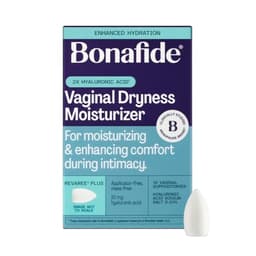
Revaree Plus
Best For
Hormone-free moisturizing with placebo-controlled evidence for its ingredient
Works In
Used on a regular schedule
Price
$70.00
$7.00 / count
Pros
- ✓Hyaluronic acid improved dryness-related quality of life versus placebo in a meta-analysis of randomized trials
- ✓Hormone-free, pre-measured inserts with no applicator
- ✓FDA 510(k) K213220 (cleared as a personal lubricant device)
Cons
- ✗About four times the price per use of Replens
- ✗No published trial of Revaree Plus by name; one small pilot funded by Bonafide, which sells it, tested a 5 mg insert
- ✗Not tested for condom compatibility; its 510(k) record lists it as not compatible with natural rubber latex, polyurethane and polyisoprene condoms
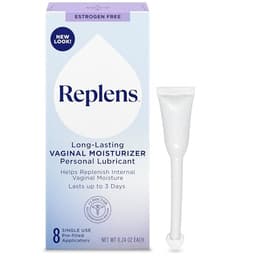
Replens Long-Lasting Vaginal Moisturizer
Best For
A low-cost, hormone-free first step for mild ongoing dryness
Works In
Used on a regular schedule
Price
$12.98
$1.62 / count
Pros
- ✓Inexpensive and widely available
- ✓Compatible with latex and polyisoprene condoms per its 510(k) record
- ✓Tested by name in several randomized trials
Cons
- ✗No clear benefit over a placebo gel for dryness in two placebo-controlled trials
- ✗Vaginal estrogen (FDA-approved, prescription) beat it in a small trial in breast cancer survivors
- ✗Hyperosmolar (1200 to 2000 mOsm/kg per its 510(k) record), so it suits scheduled moisturizing better than use as a lubricant
- ✗Not compatible with polyurethane condoms
Amazon prices retrieved from the Amazon Product Advertising API on . Prices and availability are accurate as of that time and may change.
The ratings follow this site's methodology: they grade the evidence for each product's ingredient, then adjust for practical factors such as price. Revaree Plus rates higher (3.6 vs 3.0) because hyaluronic acid has stronger placebo-controlled evidence, even after a 0.2 deduction for price. On cost per use, though, Replens is much cheaper.
Start with Replens if you have mild, ongoing dryness, cost matters, or you use latex or polyisoprene condoms. In the one direct comparison of the two ingredients, polycarbophil did as well as hyaluronic acid PMID: 35131532. Read the full Replens review.
Consider Revaree Plus if you prefer an insert with no applicator, want the ingredient with placebo-controlled support, do not rely on condoms, and the price is manageable. Read the full Revaree Plus review.
If one has not helped, trying the other is an option, but if neither helps, see a clinician rather than moving between moisturizers.
When to see a clinician
Moisturizers are for mild symptoms. See a clinician if dryness is moderate to severe, if over-the-counter products have not helped after several weeks of regular use, or if you have unusual discharge, odor, sores or urinary symptoms. Any bleeding after menopause needs to be checked, whatever you think the cause is, because it is the main warning sign of endometrial cancer, even though most women who bleed do not have cancer PMID: 30083701. For moderate to severe symptoms, NAMS recommends prescription options such as low-dose vaginal estrogen, vaginal DHEA (prasterone) and ospemifene PMID: 32852449, all FDA-approved (Vagifem (estradiol) — DailyMed Drug Label; Intrarosa (prasterone) — DailyMed Drug Label; Osphena (ospemifene) — DailyMed Drug Label), which our vaginal dryness guide explains. If you have had breast cancer or take hormone-blocking medicine, check with your oncology team before starting any new vaginal product. If you also leak urine, our guide to pelvic floor trainers covers pelvic floor muscle training and whether a device helps. If your interest in sex has dropped too, see our guide to low libido in women.