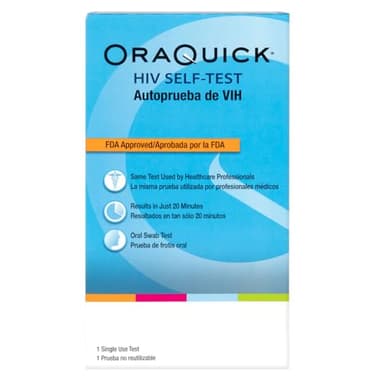
At-home testing for sexually transmitted infections (STIs, also called STDs) is a private way to check your status, but the choice is narrower than many "best of" lists suggest. Only two self-tests that give a result at home could be verified as sold on Amazon: the OraQuick HIV Self-Test and the First To Know Syphilis Test. This guide explains what each one covers, how accurate it is, when to test, and which other routes (clinics, health departments and laboratory-based kits) cover the infections these two do not. For other topics, start from our sexual health guides.
How do at-home STI tests work?
There are two kinds of at-home STI testing, and they are easy to confuse:
- Self-tests are read at home. You collect a sample, such as a gum swab or a drop of blood from a finger prick, and the device shows a result within minutes.
- Self-collection kits are mailed in. You collect a vaginal swab, urine or blood at home and send it to a laboratory, which reports results after a few days.
CDC lists FDA-approved self-test options for HIV and syphilis, a self-test for gonorrhea, chlamydia and trichomoniasis that uses a vaginal swab, and FDA-approved self-collection options for HIV, syphilis, chlamydia and gonorrhea (CDC: Getting Tested for STIs).
Self-tests are read at home, so there is no laboratory whose certification you need to check. For mail-in kits, the laboratory matters. This page does not rank any mail-in kit, because none could be verified as both sold on Amazon and processed by a laboratory whose certification is stated on the vendor's page. If you use one, check that the company names its laboratory and states its CLIA certification.
At-home STI tests that are FDA-approved or authorized
| Test | Infections covered | Sample | Result | FDA status |
|---|---|---|---|---|
| OraQuick HIV Self-Test | HIV-1 and HIV-2 (antibodies) | Gum swab (oral fluid) | At home, 20 minutes | Approved (PMA BP120001), ages 14 and older |
| First To Know Syphilis Test | Syphilis (treponemal antibodies) | Fingerstick blood | At home, about 15 minutes | De Novo authorization DEN230090, 2024 |
| Visby Medical Women's Sexual Health Test | Chlamydia, gonorrhea, trichomoniasis | Self-collected vaginal swab | At home, about 30 minutes | De Novo authorization, 2025; for females |
| LetsGetChecked Simple 2 | Chlamydia, gonorrhea | Vaginal swab or urine, mailed | From a laboratory | Marketing authorization, 2023; adults 18 and older |
Sources: FDA OraQuick approval page, FDA De Novo record DEN230090, FDA announcement on the Visby test and FDA announcement on Simple 2. Only the first two are ranked below. The other two are listed for completeness and are not linked to any retailer.
OraQuick HIV test accuracy
OraQuick looks for antibodies to HIV-1 and HIV-2 in fluid swabbed from the upper and lower gums. Its instructions report two clinical studies. In the first, 953 people, 468 of whom already knew they had HIV, ran the test and their results were compared with testing by a trained professional: 97.9% of those with a positive professional result had a matching self-test, and 99.8% of those with a negative result did. In the second, 4,999 people who did not know their HIV status tested at home: of the 96 who were positive on laboratory testing, 91.7% reported a correct result and 8.3% a false negative, while 99.9% of the 4,903 negatives were correct (OraQuick instructions for use, FDA).
Independent research is less specific to the product sold today. A WHO-commissioned meta-analysis of 25 studies, covering HIV rapid tests in general rather than OraQuick alone, found self-testers performed them about as reliably as health-care workers, with the most common error being incorrect sample collection; oral-fluid tests were less sensitive and specific than blood-based ones PMID: 29703707. In a large Zambian field study of a 2016 prototype of the OraQuick self-test, sensitivity was 87.5% against a laboratory reference that included HIV RNA testing, lower than in the FDA home-use study, and the researchers found an in-person demonstration was needed alongside the written instructions PMID: 35614397. Self-testing also brings more people to test: in randomized trials among men, offering HIV self-tests roughly doubled testing uptake PMID: 28530049.
The label lists important limits. It may not detect infections from the past 3 months. It may give a false result if you take HIV treatment, pre-exposure prophylaxis (PrEP) or post-exposure prophylaxis (PEP), and people who took part in an HIV vaccine trial may test positive without being infected. Do not eat, drink or use oral care products for 30 minutes beforehand, and read the result between 20 and 40 minutes (OraQuick instructions). Read the full OraQuick HIV Self-Test review.
First To Know syphilis test accuracy
First To Know detects antibodies to Treponema pallidum, the bacterium that causes syphilis, in a drop of fingerstick blood, with a result in about 15 minutes. In the study FDA reviewed, lay users aged 18 to 64 at six sites ran the test themselves in a simulated home setting, without help. Across 1,270 paired results (from 1,345 tests) compared with laboratory testing, the test caught 93.4% of positives (99 of 106) and correctly cleared 99.5% of negatives (1,158 of 1,164). FDA reports an invalid rate of 5.6% (75 of 1,345 tests). FDA's authorized indication is for over-the-counter use "in individuals suspected of syphilis", and states that the test "is not a substitute for visits to a healthcare provider". In laboratory cross-reactivity testing, 1 of 10 samples with Epstein-Barr virus antibodies and 1 of 10 with rheumatoid factor gave a false positive (FDA decision summary DEN230090).
The same results were published in a peer-reviewed journal, but every author worked for the manufacturer, NOWDiagnostics PMID: 40762507. No independent accuracy study was found. A 2023 systematic review of syphilis self-testing found that 88% of people given a kit used it but no published sensitivity or specificity data for syphilis self-tests at that time PMID: 37482070.
The biggest limit is that a positive result cannot tell a current infection from a past one. FDA's authorization states that results will likely be positive for people previously diagnosed with syphilis, even after successful treatment, and that the test cannot detect reinfection (FDA decision summary). CDC's treatment guidelines add that most people with a reactive treponemal test stay reactive for life, and that using only one type of syphilis blood test can miss primary syphilis or give false positives (CDC STI Treatment Guidelines: Syphilis). Read the full First To Know Syphilis Test review.
How long do at-home STI tests take, and when should you test?
The tests themselves are quick: about 20 minutes for OraQuick and about 15 minutes for First To Know, according to their FDA records above. The harder question is timing after a possible exposure, because antibody tests need time to turn positive. This delay is called the window period.
For HIV, CDC gives these typical windows (CDC: Getting Tested for HIV):
| Test type | Can usually detect HIV |
|---|---|
| Antibody test (OraQuick is one) | 23 to 90 days after exposure |
| Rapid antigen/antibody test, fingerstick blood | 18 to 90 days |
| Antigen/antibody laboratory test, blood from a vein | 18 to 45 days |
| Nucleic acid test (NAT) | 10 to 33 days |
CDC also notes that antibody tests using blood from a vein detect HIV sooner than tests using oral fluid or a finger stick. The OraQuick label says that if you may have been exposed in the past 3 months and test negative, you should test again after at least 3 months (OraQuick instructions).
If a possible HIV exposure happened in the last 72 hours, do not wait for a self-test. PEP is a prescription course of HIV medicines for emergencies, taken daily for 28 days. CDC says it must be started within 72 hours of a possible exposure, and advises talking right away to your health care provider, an emergency room doctor or an urgent care provider (CDC: Preventing HIV with PEP).
For syphilis, the First To Know records do not give a window period in days. Because CDC notes that a single type of blood test can miss primary syphilis, see a clinician for a sore or rash rather than relying on a home test (CDC syphilis guidelines).
Best at-home chlamydia test: what is available
CDC recommends yearly chlamydia and gonorrhea testing for all sexually active women under 25, but neither of the two Amazon-sold self-tests covers these infections. The two FDA-authorized at-home routes are the Visby test, a fully at-home test for females, and the Simple 2 kit, which is mailed to a laboratory (see the table above). This page does not link to either, because neither could be verified as sold on Amazon. Clinics and health departments also test for both.
Self-collected samples can be reliable. A meta-analysis of 21 studies compared self-collected with clinician-collected samples. In the six chlamydia studies that compared vaginal self-swabs with clinician-collected cervical swabs, self-swabs detected chlamydia with 92% sensitivity and 98% specificity, and for gonorrhea, urine collected by men had 92% sensitivity compared with clinician-collected urethral samples PMID: 26168051. Those studies used laboratory nucleic acid tests; they do not describe any particular commercial kit.
At-home STD test vs clinic
A home self-test is private, quick and available without an appointment. A clinic can do things a home test cannot:
- Test for several infections at once, including chlamydia, gonorrhea and hepatitis.
- Confirm a positive home result and start treatment.
- Test the throat and rectum. CDC advises people who have had oral or anal sex to ask about throat and rectal testing (CDC: Getting Tested for STIs).
- Use HIV tests with shorter window periods than an oral antibody test.
To find free or low-cost, confidential testing near you, use CDC's GetTested locator, which lists sites for HIV, STI and viral hepatitis testing by location.
What STDs are tested in a standard test?
There is no single "standard" STI panel, so ask your clinician which tests you are being given. CDC recommends (CDC: Getting Tested for STIs):
- Everyone aged 13 to 64: HIV at least once.
- Most sexually active adults: syphilis, based on where they live.
- Sexually active women under 25: chlamydia and gonorrhea every year, and some women 25 and older, such as those with new or multiple partners.
- Pregnant people: syphilis, HIV, hepatitis B and hepatitis C early in pregnancy.
- Sexually active gay and bisexual men and other men who have sex with men: syphilis, chlamydia and gonorrhea at least once a year (every 3 to 6 months with multiple or anonymous partners), and HIV at least once a year, with some benefiting from testing every 3 to 6 months.
- Anyone who shares injection drug equipment: HIV at least once a year.
CDC also notes that STIs often have no symptoms, so you may not know you have one.
Best at-home STD test for men
For men, the two at-home self-tests are the same as for anyone: OraQuick for HIV (ages 14 and older) and First To Know for syphilis. The Visby test is authorized only for females. Men who need chlamydia or gonorrhea testing can use a clinic or a laboratory-based kit; FDA's announcement says the Simple 2 kit accepts either vaginal swabs or urine samples. Men who have sex with men should follow CDC's more frequent schedule above.
Ranking the at-home self-tests sold on Amazon
These two tests do not compete: one checks for HIV and the other for syphilis, and many people will want both or a clinic panel instead. They are listed in order of evidence grade. OraQuick ranks first because, beyond its FDA studies, there is independent research on HIV self-testing, including a field study of an OraQuick prototype; First To Know's only published accuracy data come from its manufacturer. The methodology page explains the scale.
OraQuick HIV Self-Test
Best For
Private HIV screening at home, at least 3 months after a possible exposure
Works In
Result in 20 minutes; read by 40 minutes
Price
$36.99
~About $37 per test (Amazon, Oct 2026) of use
Pros
- ✓FDA-approved for home use, ages 14 and older
- ✓No needle: uses a gum swab
- ✓Self-testers read HIV rapid tests in general about as reliably as health-care workers in a meta-analysis
Cons
- ✗May miss infections from the past 3 months
- ✗8.3% false negatives in the FDA home-use study
- ✗Not for people taking HIV treatment, PrEP or PEP, per the label
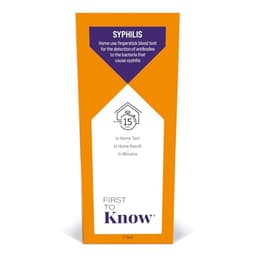
First To Know Syphilis Test
Best For
People never diagnosed with syphilis who suspect they may have it and want a first test at home
Works In
Result in about 15 minutes
Price
$24.97
$24.97 / count
Pros
- ✓FDA describes it as the first at-home, over-the-counter syphilis antibody test
- ✓93.4% positive and 99.5% negative agreement with laboratory testing in its FDA study
- ✓Fingerstick sample, no laboratory needed
Cons
- ✗Will likely stay positive after past, treated syphilis
- ✗Only published accuracy study is by the manufacturer
- ✗FDA reports a 5.6% invalid rate (75 of 1,345 tests)
Amazon prices retrieved from the Amazon Product Advertising API on . Prices and availability are accurate as of that time and may change.
After a positive, negative or unclear result
Positive result. Both labels treat a positive home result as preliminary. The OraQuick instructions say a doctor, clinic or health care professional must confirm the result, and not to use a second OraQuick test to confirm it (OraQuick instructions). CDC says a positive HIV self-test should be followed by laboratory testing (CDC: Getting Tested for HIV). For syphilis, the test's FDA-authorized indications state that a positive result must be followed by laboratory testing through a health care provider, and that its results should not be used to start, stop or change any treatment without one (FDA decision summary).
Negative result. A negative result does not rule out infection. It may reflect the window period, and both tests missed some infections in their FDA studies. OraQuick's label also says not to use a result to make decisions about behaviour that may put you at increased risk for HIV. If your possible exposure was recent, retest as described above or see a clinician. A negative HIV or syphilis test also says nothing about chlamydia, gonorrhea, trichomoniasis, herpes or other infections.
Invalid or unclear result. An invalid result is not a negative one. Follow the kit's instructions on retesting (the First To Know labeling explains when to re-test after an invalid result, per its FDA decision summary DEN230090), or visit a testing site.
See a clinician promptly if you have a genital sore, rash, unusual discharge, pain on passing urine, or pelvic pain, whatever a home test shows. An exam can also look for causes other than infection; our vaginal dryness guide covers when irritation or dryness needs one.
Lowering your risk between tests
Condoms are not 100% effective, but they help. An earlier NIH review had concluded that condoms protect against HIV, and a later review of prospective studies found condom use was also linked to significant protection against chlamydia, gonorrhea, genital herpes (HSV-2) and syphilis PMID: 15356939. If you use a lubricant with condoms, choose one that is compatible with your condom type; our lubricant guide explains which are safe with latex. Our condom guide compares latex and latex-free condoms, including options for people with a latex allergy. If you are at ongoing risk of HIV, ask a clinician about PrEP, prevention medicine taken as pills or shots on an FDA-approved schedule (CDC: Preventing HIV with PrEP). People on PrEP receive regular HIV testing as part of their care (CDC: Getting Tested for HIV).