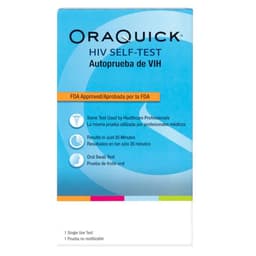
What OraQuick is
The OraQuick HIV Self-Test, made by OraSure Technologies, is a single-use test for antibodies to HIV-1 and HIV-2 in oral fluid. FDA approved it for consumer use by people aged 14 and older under PMA BP120001 (FDA OraQuick approval page). You swab your upper and lower gums once each with the test stick, place it in the developer tube, and read the result after 20 minutes but before 40 minutes. The label says not to eat, drink or use oral care products for 30 minutes beforehand (OraQuick instructions for use).
Accuracy in FDA studies and independent research
The instructions report two clinical studies. In the first, 953 people (468 of whom already knew they had HIV) ran the self-test and their results were compared with those from a trained professional: 97.9% of positives and 99.8% of negatives matched. In the second, 4,999 people who did not know their HIV status tested at home and reported their result: 91.7% of the 96 people with HIV reported a correct positive (8.3% were false negatives), and 99.9% of the 4,903 without HIV reported a correct negative. Across both studies, 1.54% of people did not get a result (OraQuick instructions).
A WHO-commissioned meta-analysis of 25 studies of HIV rapid tests in general, not OraQuick alone, found self-testers did them about as reliably as health-care workers, with incorrect sample collection as the most common error and lower accuracy for oral-fluid than blood-based tests PMID: 29703707. In a Zambian field study of a 2016 prototype of the OraQuick self-test, sensitivity was 87.5% against a laboratory reference that included HIV RNA testing PMID: 35614397, which is one reason a negative result cannot rule out infection.
The 3-month window and other limits
OraQuick is an antibody test, and antibodies take time to appear. The label says it may not detect infections from the past 3 months (OraQuick instructions), and CDC says antibody tests usually detect HIV 23 to 90 days after exposure, with oral-fluid tests detecting it later than tests on blood from a vein (CDC: Getting Tested for HIV). If a possible exposure happened in the last 72 hours, CDC says post-exposure prophylaxis (PEP), a 28-day prescription course of HIV medicines, must be started within 72 hours, so contact a clinician, urgent care or emergency department rather than waiting to test (CDC: Preventing HIV with PEP).
The label also warns that people taking HIV treatment, PrEP or PEP may get a false result, and that people who took part in an HIV vaccine trial may test positive without being infected. It also says not to use the result to make decisions about behaviour that may put you at increased risk for HIV (OraQuick instructions).
Is OraQuick right for you?
Consider OraQuick if you want a private HIV test at home and your last possible exposure was at least 3 months ago, or as part of regular testing. It does not test for any other infection; the First To Know test covers syphilis, and our at-home STD testing guide explains the options for chlamydia and gonorrhea.
Use a clinic or testing site instead if your possible exposure was recent, you take PrEP or HIV treatment, or you want several infections checked at once. CDC's GetTested locator lists free or low-cost, confidential testing near you. Any positive OraQuick result needs confirmatory testing through a clinician.